FUDOKI: Discrete Flow-based Unified Understanding and Generation via Kinetic-Optimal Velocities
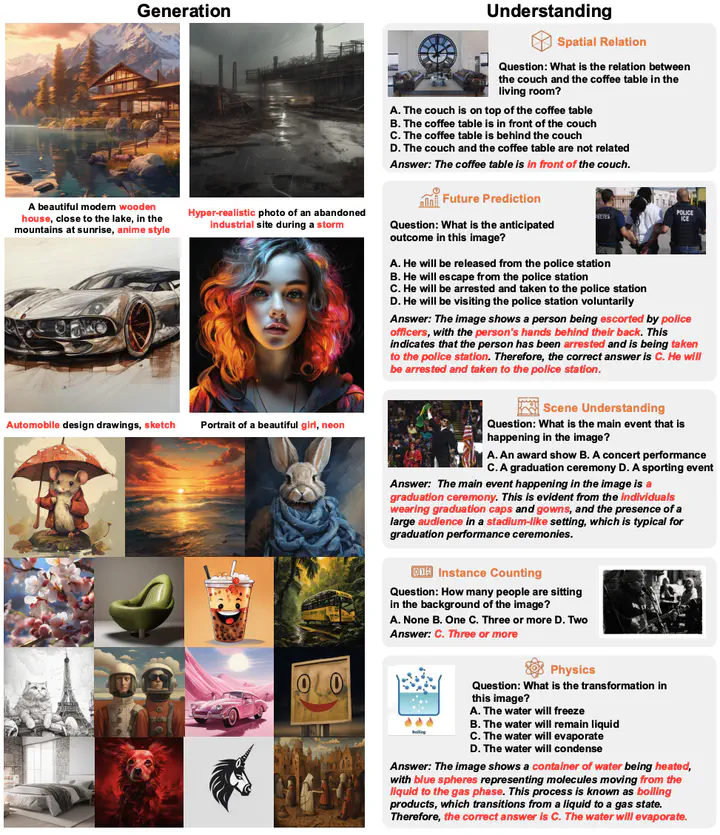 Results of FUDOKI
Abstract
The rapid progress of large language models (LLMs) has catalyzed the emergence of multimodal large language models (MLLMs) that unify visual understanding and image generation within a single framework. However, most existing MLLMs rely on autoregressive (AR) architectures, which impose inherent limitations on future development, such as the raster-scan order in image generation and restricted causal context modeling. In this work, we challenge the dominance of AR-based approaches by introducing FUDOKI, a unified multimodal model based on discrete flow matching, as an alternative to conventional AR paradigms. By leveraging metric-induced probability paths with kinetic optimal velocities, our framework goes beyond the previous masking-based corruption process, enabling iterative refinement and richer bidirectional context integration during generation. To mitigate the high cost of training from scratch, we initialize Fudoki from pre-trained AR-based MLLMs and adaptively transition to the discrete flow matching paradigm. Experimental results show that Fudoki achieves performance comparable to state-of-the-art AR-based MLLMs across both visual understanding and image generation tasks, highlighting its potential as a foundation for next-generation unified multimodal models.

Jin Wang
CS PhD Student at HKU
My research focuses on multimodal foundation models, especially unified systems that connect visual understanding, generation, and evaluation, with earlier work in deepfake detection and AI interpretability.